
Key Takeaways
- Agentic AI doesn’t just generate content. It takes autonomous actions on live business data, creating security risks that traditional controls weren’t built to handle.
- The biggest gaps aren’t in model design but in data: What agents access, how it flows between systems, and whether you can recover when something fails.
- Six key threat areas, from prompt injection to shadow AI, need attention before AI agents go to production.
- A practical best-practices framework can reduce agentic AI risk without slowing down adoption.
- Veeam closes the auditability and recovery gap, enabling organizations to secure their data so AI agents can operate safely at scale.
Agentic AI security is the set of policies, controls, and data protection strategies that govern how autonomous AI agents access, process, and act on sensitive business data. It’s a fast-emerging discipline, and one most organizations haven’t caught up with yet.
Here’s why it matters: Generative AI produces outputs: It writes an email, summarizes a document, or drafts a report. Agentic AI goes further. It executes actions. It calls APIs, invokes functions, queries databases, and modifies systems. That’s a fundamentally different security model.
Here’s a real-world difference. A generative AI tool might draft a response to an employee’s HR question. An agentic AI system connects to your HR platform, pulls the employee’s record, updates their profile in Workday, and triggers a downstream workflow, all without a human reviewing each step. The value is obvious. So is the risk.
McKinsey reports that 80% of organizations have already encountered risky behaviors from AI agents, including improper data exposure and unauthorized system access. And yet, most security teams are still applying controls that were designed for a world where software followed deterministic rules, not one where autonomous agents make judgment calls on live data.
This article breaks down how agentic AI introduces new security risks, the six specific threat areas security leaders and CIOs need to understand, a practical best-practices framework to reduce risk without blocking adoption, and how to close the data protection gaps that existing tools leave open.
How Agentic AI Introduces New Security Risks
Traditional AI security focuses on what a model says: its outputs, hallucinations, and biases. Agentic AI shifts the risk to what the agent does. The APIs it calls, the functions it invokes, the systems it modifies. That action layer is where security failures happen, and it’s where attackers focus.
Unlike a chatbot that generates a response and waits for the next prompt, an agentic AI system takes autonomous actions in sequence, often without human approval at each step. That autonomy is what makes these systems powerful. It’s also what expands the blast radius of any security failure from a single bad output to a chain of unauthorized actions. In practice, that means an agent can:
- Read and copy sensitive files across repositories
- Send emails or messages on behalf of users
- Query databases containing customer or financial data
- Execute code or trigger workflows in production systems
The least privilege problem is the most common starting point for risk. Most agentic AI deployments are granted broad data access during initial setup (email, cloud storage, CRM, and internal knowledge bases) and that access is rarely scoped down or reviewed after deployment. The result is an over-privileged autonomous system operating inside sensitive environments, with more access than it needs and less oversight than it should have.
Making this worse, agentic AI systems generate, store, and transmit data continuously as part of normal operations. Every query, every API call, every inter-agent handoff creates a data trail. In most organizations, that trail is untracked and ungoverned, invisible to the security teams responsible for protecting it.
This combination creates a fundamentally different security challenge, one that controls built for traditional software, and even for generative AI, don’t cover:
- Autonomous action: Agents act without human review at each step
- Over-privileged access: Broad permissions granted at setup and never revisited
- Ungoverned data flows: Continuous data generation and transmission with no tracking or audit trail
What Are the Main Agentic AI Security Risks?
Before deploying or approving AI agents, security leaders and CIOs need a clear picture of the specific failure modes these systems introduce. The threat landscape for agentic AI goes beyond traditional cybersecurity risks. It includes attack vectors that exploit the agent’s autonomy, its access to live data, and the trust relationships between agents in multi-agent environments.
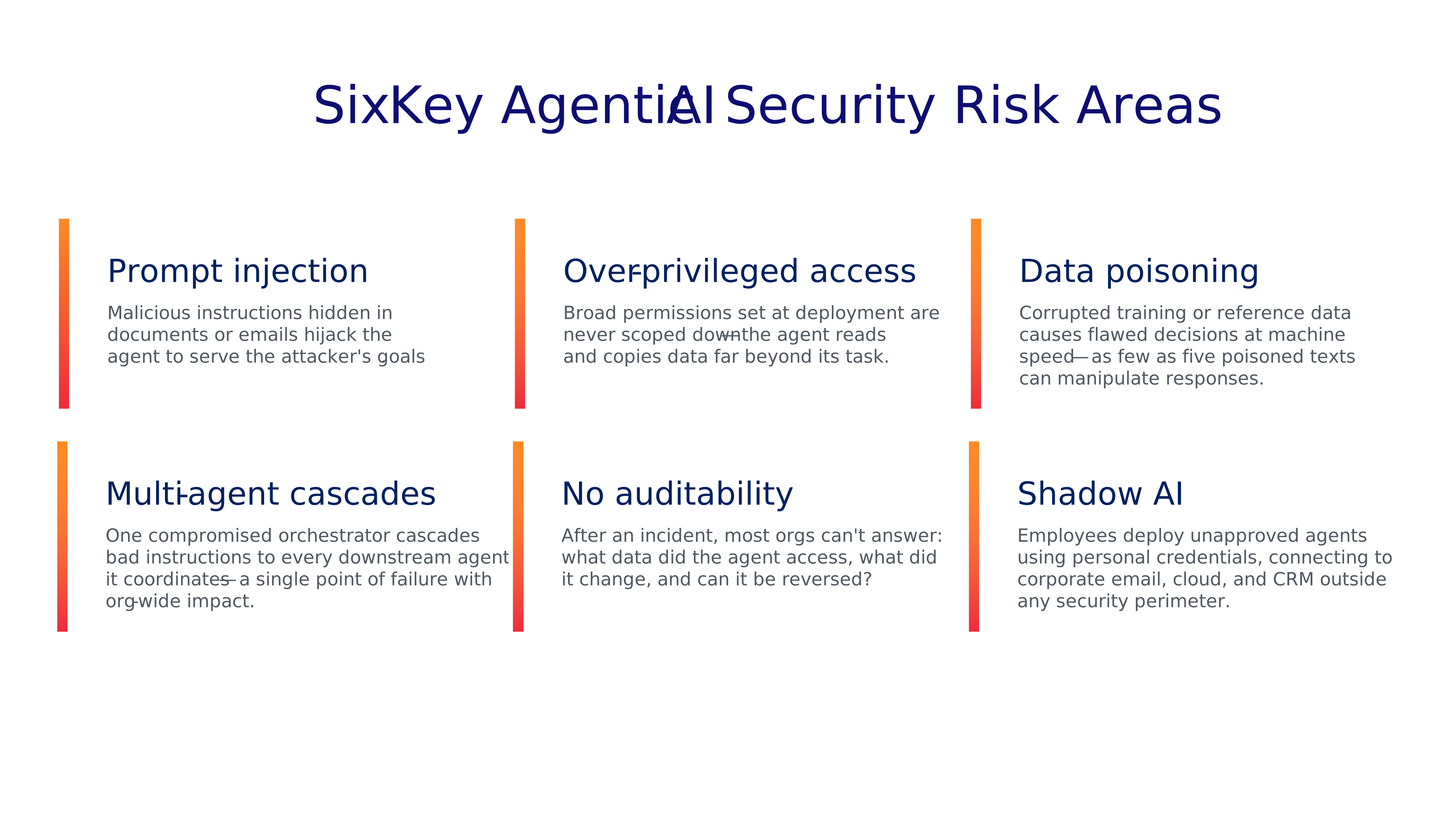
Here are the six risk areas that matter most.
Prompt Injection and Input Manipulation
Prompt injection happens when an attacker embeds malicious instructions in data the agent reads (a web page, a document, an email, or a database record) causing it to take unintended actions that serve the attacker’s goals rather than those of the user.
This is an agentic-specific threat that doesn’t exist in the same form for traditional software. A conventional application follows deterministic logic. An agentic AI system interprets and acts on natural language, which makes it uniquely vulnerable to instructions hidden in otherwise normal-looking content. The agent doesn’t distinguish between legitimate input and an embedded command. It processes both the same way.
Unauthorized and Over-Privileged Data Access
AI agents with overly-permissive access can read, copy, or exfiltrate sensitive data, often without triggering traditional data loss prevention (DLP) controls. The reason is simple: The action looks like legitimate system behavior coming from a trusted application. And to most monitoring tools, the agent is just another authorized service making API calls.
Multi-agent environments compound this risk. When agents pass data between each other as part of a workflow, there are no human checkpoints at each handoff. Sensitive data can move from a tightly-governed system to a less protected one without anyone noticing or approving.
Data Poisoning
Data poisoning occurs when an attacker corrupts the data an AI agent relies on, causing it to make flawed or malicious decisions at scale. Research shows, for example, that PoisonedRAG used as few as five poisoned texts to manipulate AI responses with high success rates.
The implication is significant: In an agentic AI environment, all data the agent reads is effectively sensitive data, including training data, reference documents, and knowledge bases. Everything the agent uses to make decisions must be protected with the same rigor as credentials or PII. This is especially dangerous for agents involved in:
- Security operations and threat detection
- Compliance monitoring and regulatory reporting
- Financial analysis and decision-making
If the data feeding these agents is compromised, the downstream decisions are compromised too, at machine speed and at scale.
Multi-Agent and Orchestration Risks
In multi-agent systems, a single orchestration agent typically coordinates the work of several downstream agents. If that orchestrator is compromised or manipulated, it can cascade bad instructions to every agent it manages, creating a single point of failure with organization-wide impact.
Agent-to-agent communication channels are a new attack surface that traditional security monitoring wasn’t built to observe. These interactions happen programmatically, often without logging, and can be exploited to move laterally across systems in ways that don’t trigger conventional alerts.
Lack of Auditability and Recovery
After an AI-related incident, most organizations can’t answer three basic questions:
- What data did the agent access?
- What actions did it take?
- Can those actions be reversed?
This isn’t a minor operational gap. It’s a foundational one. Traditional backup and recovery tools were not designed for the data flows that agentic systems generate. They can’t trace what an agent did across multiple systems, and they can’t surgically undo a specific agent’s action without reverting entire environments. That gap between “something went wrong” and “here’s exactly what happened and how to fix it” is where the real risk lives.
Shadow AI and Ungoverned Agents
Shadow AI is already widespread. Employees are deploying AI agents without IT or security approval, connecting them to corporate data sources like email, cloud storage, and CRM systems using personal credentials. These agents operate entirely outside the organization’s security perimeter, creating ungoverned data flows that no one is tracking.
The risk goes beyond policy violations. Shadow AI agents bypass all access controls, operate without logging, and can expose sensitive data to third-party services without any oversight. And because they’re invisible to security teams, the organization often doesn’t know they exist until something goes wrong.
What Are Agentic AI Security Best Practices?
Understanding the risks is the first step. The next is building an operational framework that reduces those risks without blocking AI adoption. The best practices below give security leaders and CIOs a practical starting point: Controls and policies that can be implemented incrementally, starting before agents go to production and continuing as deployments scale.
None of these practices work in isolation. They reinforce each other, and the strongest agentic AI security posture comes from applying them together.
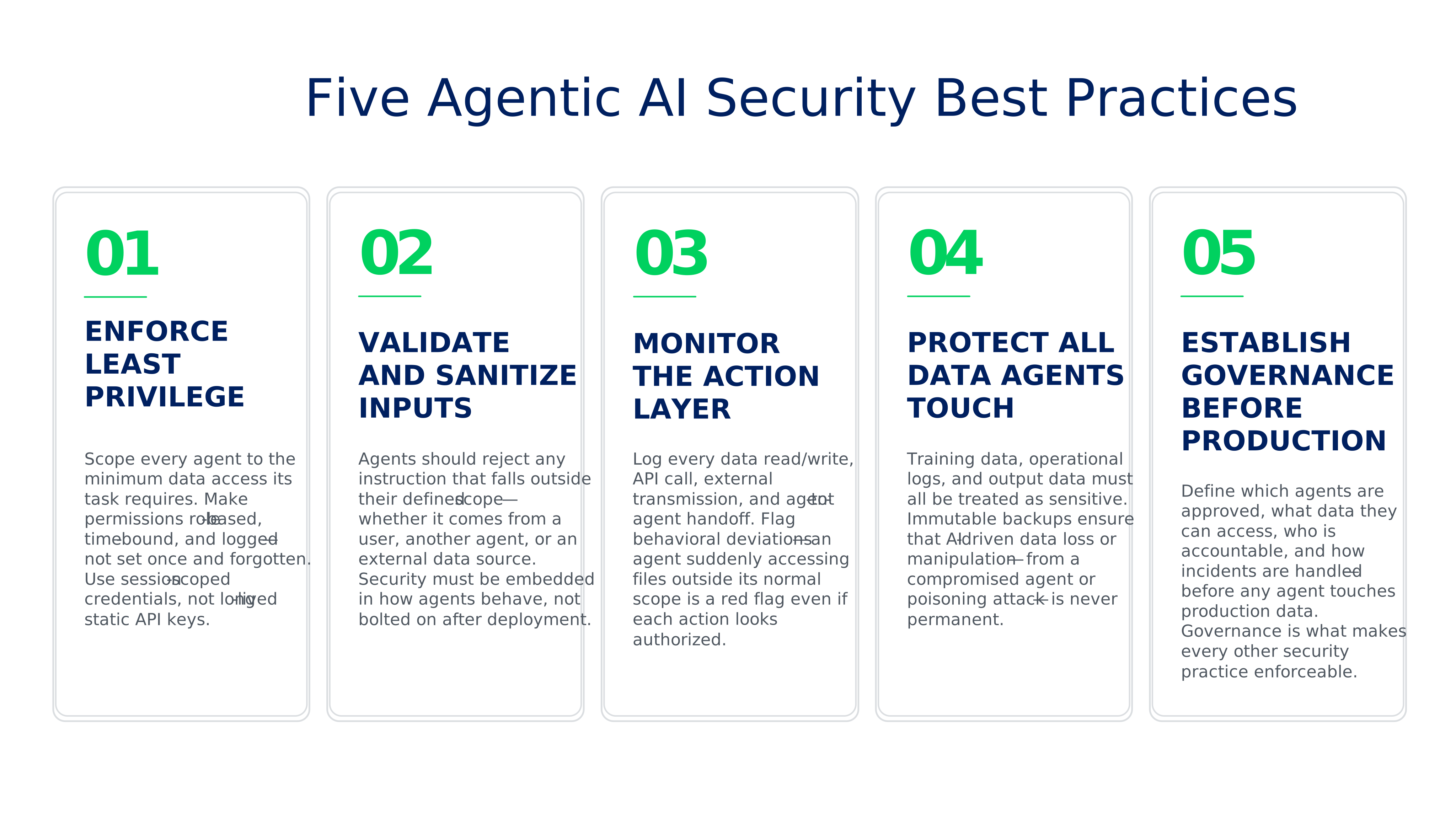
1. Enforce Least Privilege for AI Agents
Every AI agent should be scoped to the minimum data access required for its specific task, and that scope should be reviewed and revalidated regularly, not set once at deployment and forgotten.
Agent permissions should be:
- Role-based: Tied to the agent’s defined function, not a generic service account
- Time-bound: Limited to active sessions or defined windows rather than always-on
- Logged: Every access event recorded for audit and anomaly detection
Dynamic credentials that expire after each session are preferable to static, long-lived API keys. Static keys are easy to configure and easy to forget, which is exactly what makes them a risk in environments where agents operate autonomously and continuously.
2. Validate and Sanitize Agent Inputs
Because prompt injection uses the agent’s own capabilities against it, input sanitization is one of the most critical controls available. Agents should be designed to validate every input and reject instructions that deviate from their defined scope, whether those instructions come from a user, another agent, or an external data source.
This requires security to be embedded in how agents think and behave, not bolted on after deployment. An agent that can’t distinguish between a legitimate task instruction and a malicious prompt embedded in a document isn’t safe to operate on sensitive data, regardless of how strong the perimeter controls are around it.
3. Monitor Agent Activity Across the Action Layer
Monitoring agentic AI systems means going beyond traditional endpoint or network monitoring. In an agentic context, effective monitoring looks like logging every:
- Data read and write operation
- API call and external transmission
- Agent-to-agent communication and handoff
- Permission escalation or scope change
Anomaly detection for agents should flag behavioral deviations, not just known threat signatures. An agent that suddenly starts accessing files outside its normal scope, calling APIs it hasn’t used before, or transmitting data to unfamiliar endpoints is a red flag, even if each individual action looks technically authorized.
The goal isn’t to create friction. It’s to create visibility where none currently exists.
4. Protect Data Touched by AI Agents
Data accessed, generated, or transmitted by AI agents, including training data, operational logs, and output data, must be protected with the same rigor as any other sensitive business data. In an agentic environment, all data the agent interacts with is effectively sensitive, because it directly shapes the agent’s decisions and actions.
This is where immutable backups become essential. Immutable backups ensure that AI-driven data loss or manipulation, whether from a compromised agent, a data poisoning attack, or an accidental destructive action, isn’t permanent. They provide a clean, verified recovery point that can’t be altered or deleted by the same agent (or attacker) that caused the problem.
Without immutable backups, a single agent error or compromise can cause irrecoverable data loss.
5. Establish AI Governance Before Agents Go to Production
A formal AI governance policy should define the ground rules before any agent touches production data. At minimum, that policy needs to answer:
- Which agents are approved to operate, and in what environments?
- What data can each agent access, and under what conditions?
- Who is accountable for an agent’s behavior and decisions?
- How are incidents detected, reported, and remediated?
Governance must extend to runtime action control, not just training validation or pilot-stage approvals. An agent that passed review during a proof of concept may behave very differently once it’s operating at scale with broader data access and new integrations.
This is the practice that makes every other security control enforceable. Without governance, there’s no mechanism to enforce least privilege, mandate credential rotation, or require monitoring at scale. It’s the difference between having best practices on paper and having them embedded in operations.
How Veeam Protects Data in Agentic AI Environments
The best practices above give organizations a framework. But frameworks need infrastructure behind them, especially when it comes to the auditability and recovery gaps that agentic AI exposes. This is where Veeam fits in.
Veeam is purpose-built for the environments where agentic AI operates: Cloud-native, hybrid, and multi-cloud. As the Data and AI Trust Company, Veeam enables organizations to secure their data so AI agents can operate safely, giving teams the confidence to scale AI adoption without sacrificing visibility, control, or recoverability.
Closing the auditability and recovery gap. Most organizations today can’t trace what an AI agent accessed, what it changed, or how to undo it. Veeam addresses this directly by giving security and IT teams the ability to:
- See what AI agents touched: Full visibility into the data affected by agent actions across production and backup environments
- Recover from AI-driven data loss or manipulation: Whether caused by a compromised agent, a data poisoning attack, or an accidental destructive action
- Maintain backup coverage for dynamic data flows: Protecting the continuous data trails that agentic systems generate, not just static datasets
Immutable backups as the safety net. Immutable backup capabilities ensure that AI-related incidents don’t result in permanent data loss. When an agent makes an unwanted change, you need a clean, verified recovery point that the agent, or the attacker behind it, can’t alter or delete.
Veeam DataAI Agent Commander takes this further by unifying AI risk detection, policy enforcement, and precision recovery in a single solution. At its core is the DataAI Command Graph , a real-time intelligence engine that maps live connections between data, identities, AI models, and autonomous agents across your entire environment. Agent Commander lets teams surface shadow AI and hidden risks, enforce granular controls across data and agents, and surgically reverse unwanted AI actions without reverting entire systems. It’s the control layer that turns agentic AI from an unmanaged risk into a governed, recoverable operation.
Explore Data Security for AI for frameworks and Contextual Data and AI for CIO-level insights.
FAQ
Agentic AI security is the set of policies, controls, and data protection strategies that govern how autonomous AI agents access, process, and act on sensitive business data. It covers access management, input validation, activity monitoring, governance, and recovery, specifically for AI systems that take independent actions, not just generate content.
Generative AI produces outputs like text, images, or summaries. Agentic AI executes actions: calling APIs, modifying records, querying databases, and triggering workflows autonomously. The security risk shifts from a bad output to an unauthorized action on live business data.
The six primary risks are prompt injection, unauthorized and over-privileged data access, data poisoning, multi-agent orchestration failures, lack of auditability and recovery, and shadow AI. Each exploits the agent’s autonomy, its data access, or trust relationships between agents.
Enforce least privilege access for every agent. Validate and sanitize all inputs. Monitor activity across the action layer. Protect all data agents’ touch with immutable backups. Establish formal AI governance before agents reach production. These controls are most effective when applied together.
Agent Commander is Veeam’s unified solution for detecting AI risk, protecting AI systems, and undoing AI mistakes. Powered by the DataAI Command Graph, it maps real-time connections between data, identities, AI models, and autonomous agents to deliver visibility, control, and precision recovery at scale.
Yes. Immutable backups ensure AI-driven data loss or manipulation isn’t permanent. Veeam’s DataAI Agent Commander enables teams to see a complete timeline of agent actions, pinpoint the exact change to reverse, and restore with precision, without reverting entire systems.
The post Agentic AI Security: How to Protect Data in an AI-Driven World appeared first on Veeam Software Official Blog.
from Veeam Software Official Blog https://ift.tt/SaodnEG
Share this content: